
You have the design.
You have the shirts.
Now comes an important question:
How should your design actually be printed?
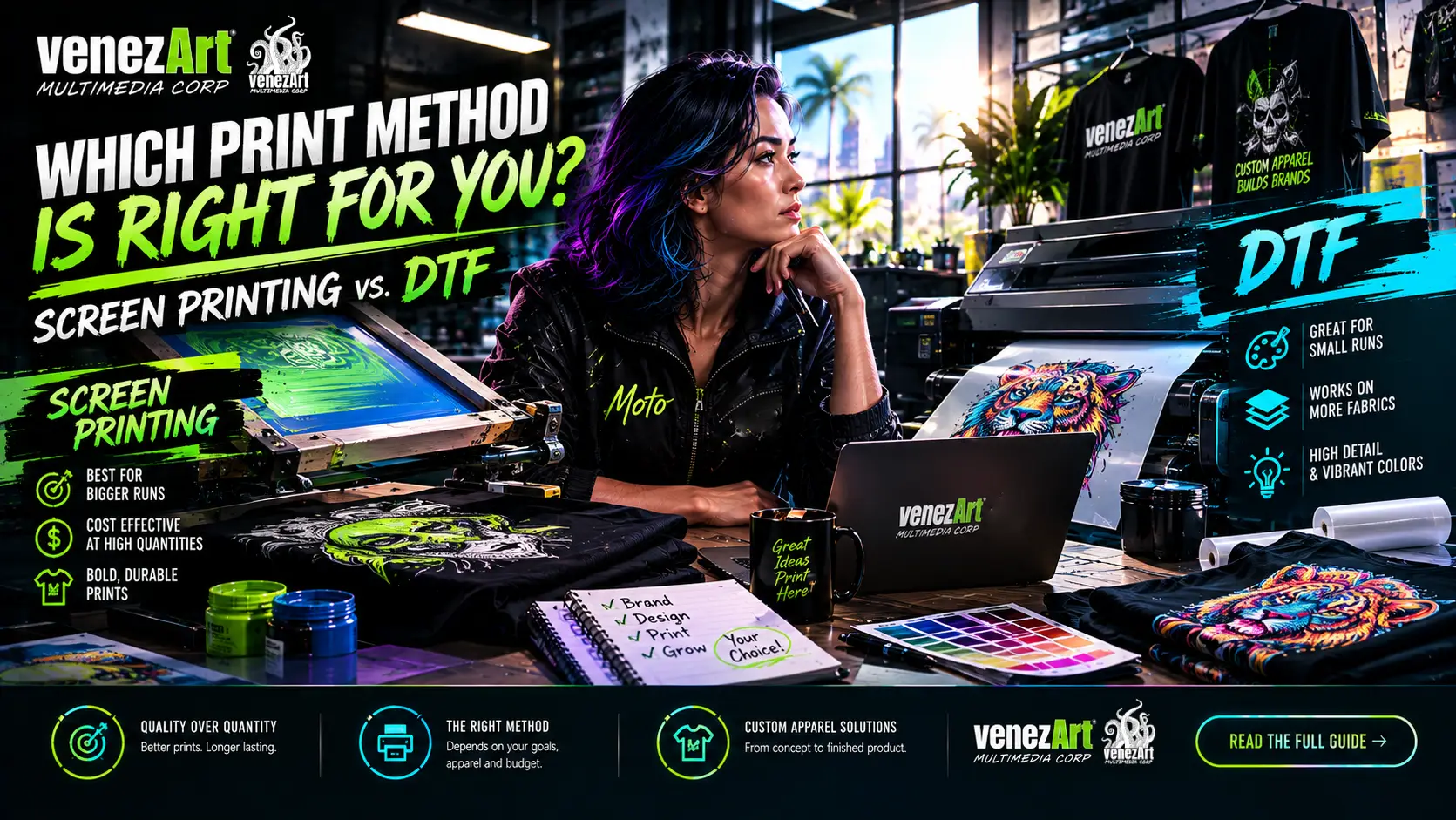
When it comes to custom apparel, two popular options are screen printing and DTF (Direct-to-Film) printing.
Both can produce great results.
But they work differently—and choosing the right method can make a big difference in print quality, cost, durability, color, and production.
What Is Screen Printing?
Screen printing is one of the most established methods for decorating apparel.
Instead of printing the entire image directly onto the shirt, ink is pushed through a prepared screen onto the garment.
Each color typically requires its own screen and setup.
Screen printing works especially well for:
🎯 Company logos
👕 T-shirts and uniforms
📦 Larger apparel orders
🎨 Designs using solid colors
🏢 Business and organization apparel
🔥 Bold, durable graphics
One of the biggest advantages?
Durability.
When properly produced and cured, screen-printed designs can provide excellent wash resistance and a professional, traditional apparel-printing finish.
Screen printing can also become more cost-effective as quantities increase because the setup is spread across more garments.
But there is a tradeoff.
Complex, full-color artwork can require additional preparation, color separation, and production steps.
That can make screen printing less practical for certain designs or very small orders.
What Is DTF Printing?
DTF stands for Direct-to-Film.
Instead of printing directly onto the shirt, the artwork is printed onto a special transfer film.
The design is then coated with adhesive powder, cured, and heat pressed onto the garment.
DTF is especially useful for:
🌈 Full-color artwork
📸 Detailed graphics
🎨 Digital illustrations
🖼️ Gradients and photographic images
👕 Small production runs
🧪 Designs requiring multiple colors
One of the biggest advantages of DTF?
Flexibility.
You can produce highly detailed, full-color designs without creating a separate screen for every color.
That makes DTF an excellent option for custom designs, short runs, personalization, and artwork with lots of color and detail.
For example, imagine you want ten shirts featuring a detailed illustration with multiple colors, gradients, and small details.
DTF may be a more practical production solution than setting up multiple screens.
Screen Printing vs. DTF: What’s the Difference?
SCREEN PRINTING
✔ Excellent for larger quantities
✔ Great for bold graphics and logos
✔ Excellent durability
✔ Strong option for uniforms and company apparel
✔ Cost can become more attractive at higher quantities
❌ Requires setup
❌ Multiple colors can increase production complexity
❌ Not always the most efficient choice for small, highly detailed designs
DTF PRINTING
✔ Excellent for full-color designs
✔ Great for detailed artwork
✔ Excellent for gradients and illustrations
✔ Ideal for small and medium production runs
✔ Easy to personalize designs
✔ No traditional screen setup for each color
❌ The print can feel different from traditional screen printing
❌ Large production runs may favor other methods depending on the project
❌ Artwork still needs to be properly prepared
⚠️ But Here’s an Important Detail…
The best print method isn’t determined by the artwork alone.
The right choice depends on the entire project.
Consider:
How many shirts are you printing?
A small custom order may make DTF a practical choice.
A large order of shirts with a simple logo may be better suited for screen printing.
How complex is the artwork?
A simple one- or two-color logo can be an excellent screen-printing candidate.
A detailed illustration with gradients, shadows, and many colors may be better suited for DTF.
What type of garment are you using?
T-shirts, hoodies, uniforms, performance apparel, and other garments can have different production considerations.
What result are you looking for?
Sometimes you want the traditional look and feel of screen printing.
Other times, you need highly detailed, full-color artwork.
The goal isn’t simply to choose the newest or most popular method.
The goal is to choose the right production method for your project.
Your Design Is Part of the Production Process
Custom apparel isn’t just about choosing a shirt and putting an image on it.
Your design, artwork file, garment, print method, quantity, and production requirements all work together.
The right decision can affect:
✔ Print quality
✔ Color reproduction
✔ Durability
✔ Production time
✔ Cost per garment
✔ Artwork detail
✔ Consistency across an order
✔ The final appearance of your brand
That is why professional apparel planning matters.
At VenezArt, we don’t just ask:
“What do you want printed?”
We look at the bigger picture.
What are you printing?
How many do you need?
What does the artwork look like?
What type of garment are you using?
And most importantly:
Which production method makes the most sense for your project?
Whether you’re creating company uniforms, promotional shirts, event apparel, branded merchandise, or a new apparel line, choosing the right method before production can help you get a better result.
Not Sure Which Method You Need?
That’s where VenezArt can help.
Send us your artwork, tell us what you’re looking to produce, and we’ll help you determine whether screen printing, DTF, or another production method makes the most sense for your project.
Because great apparel starts with more than a great design.
It starts with the right production strategy.
Ready to Put Your Brand on Apparel?
Let’s talk about your next custom apparel project.
Build Trust. Get Found. Generate Leads.
Schedule a quick consultation with VenezArt and let’s figure out the right way to bring your design to life.


