
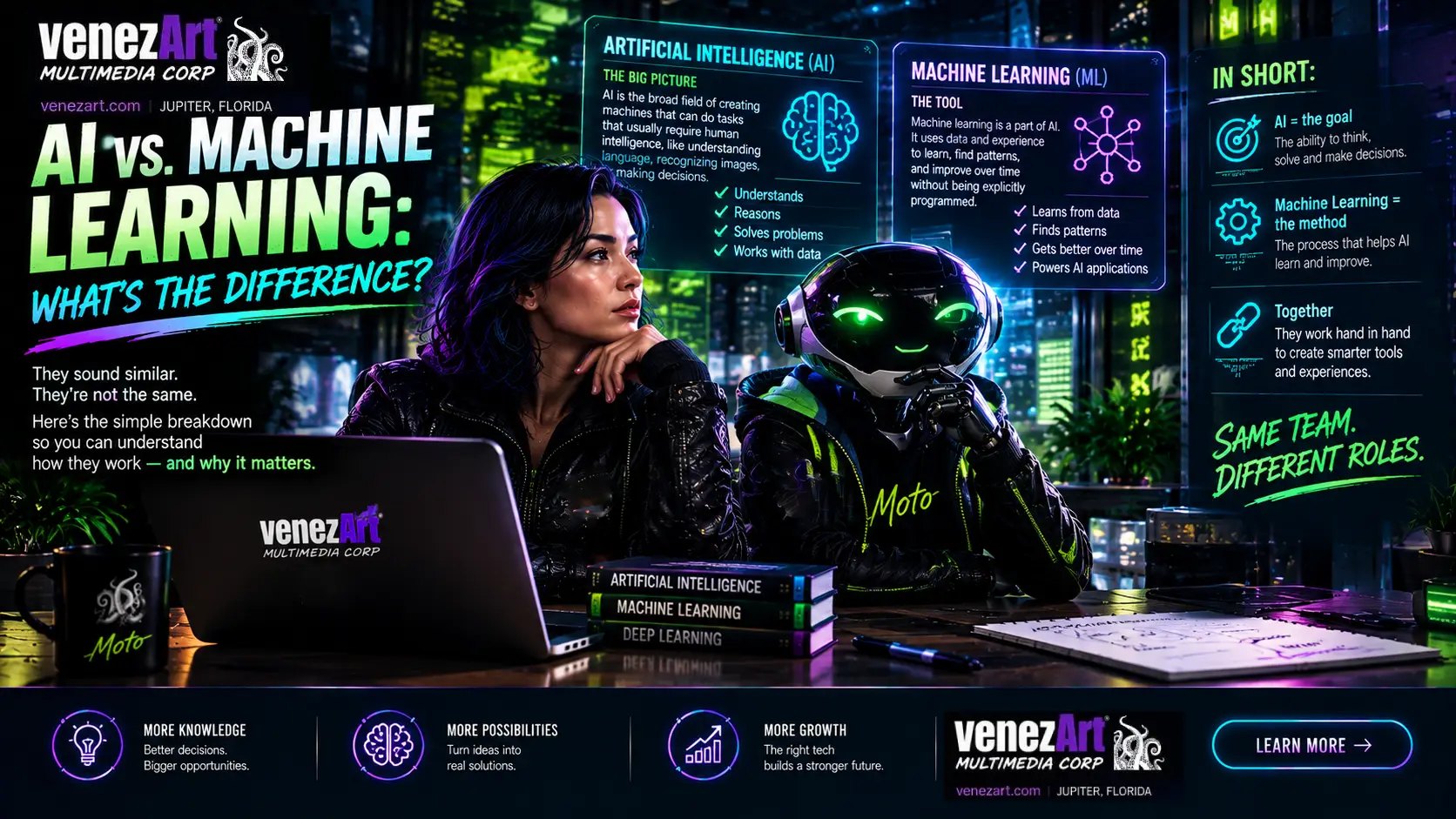
When you start learning about artificial intelligence (AI), you may hear people use the terms AI and machine learning as if they mean the same thing. They are closely connected, but they are not the same.
So, what is the difference?
What Is Artificial Intelligence?
Artificial intelligence (AI) is a broad field focused on creating technology that can perform tasks that normally require human intelligence.
AI can be used for many different tasks. For example, it can:
- Write emails and articles
- Create images and videos
- Answer questions
- Recommend products
- Suggest driving routes
- Help people analyze information
AI can seem very smart, but it does not know everything. What an AI system can do depends on the data, instructions, and training it receives.
This is where machine learning becomes important.
What Is Machine Learning?
Machine learning (ML) is one of the main ways AI systems learn from data.
Instead of programming an AI system with instructions for every possible situation, machine learning allows the system to find patterns in large amounts of data.
For example, imagine you want an AI system to tell the difference between zebras and horses.
You could give the machine learning system thousands of pictures of both animals. Over time, the system looks for patterns and features that help separate the two.
It may learn that zebras have unique stripes while horses normally have solid-colored coats.
After training, the AI can look at a new picture it has never seen before and make a prediction about whether it shows a zebra or a horse.
This process is called inference.
The example shows why training data matters. The quality and amount of data used to train an AI system can affect how well it performs.
Three Common Machine Learning Approaches
There are three common approaches to machine learning:
- Supervised learning
- Unsupervised learning
- Reinforcement learning
Each approach teaches AI in a different way.
1. Supervised Learning
Supervised learning uses data that has already been labeled by people.
For example, people could label millions of pictures as either “zebra” or “horse.”
The machine learning system studies these labeled examples and learns the differences between the two animals.
Later, it can use what it learned to classify new pictures.
Supervised learning is useful when you already know the types of answers or categories you want the AI to find.
2. Unsupervised Learning
Unsupervised learning uses data that has not been labeled by people.
Instead of telling the AI which pictures show zebras or horses, you give it a large collection of animal pictures.
The AI looks for patterns on its own.
It might notice that some animals have stripes while others have solid-colored coats. It can then group similar images together.
This approach is useful when you want AI to discover patterns or groups in data without giving it the answers first.
3. Reinforcement Learning
Reinforcement learning teaches AI through trial and error.
The system tries to complete a task and receives feedback based on the result.
For example, imagine an AI system is learning to identify zebras in videos.
When it makes a correct prediction, it receives a reward. When it makes a wrong prediction, it receives a penalty.
After many attempts, the system learns which actions produce better results. It uses this experience to improve its performance.
How AI and Machine Learning Work Together
AI and machine learning are closely connected, but they are not the same thing.
Think of AI as the larger field and machine learning as one of the important tools used to build AI systems.
Machine learning allows AI systems to learn from data, recognize patterns, and improve how they perform certain tasks.
Today, many AI systems use a combination of supervised learning, unsupervised learning, and reinforcement learning.
These techniques help power AI tools that can create text, images, video, music, and more.
Understanding the relationship between AI and machine learning can help you better understand how today’s AI technology works—and why the data used to train AI matters.
