
You have a logo.
You have artwork.
It looks perfect on your phone or computer.
So why does the printer keep asking for a vector file?
When it comes to custom apparel, screen printing, embroidery, DTF, and promotional products, the type of artwork file you provide can have a major impact on the final result.
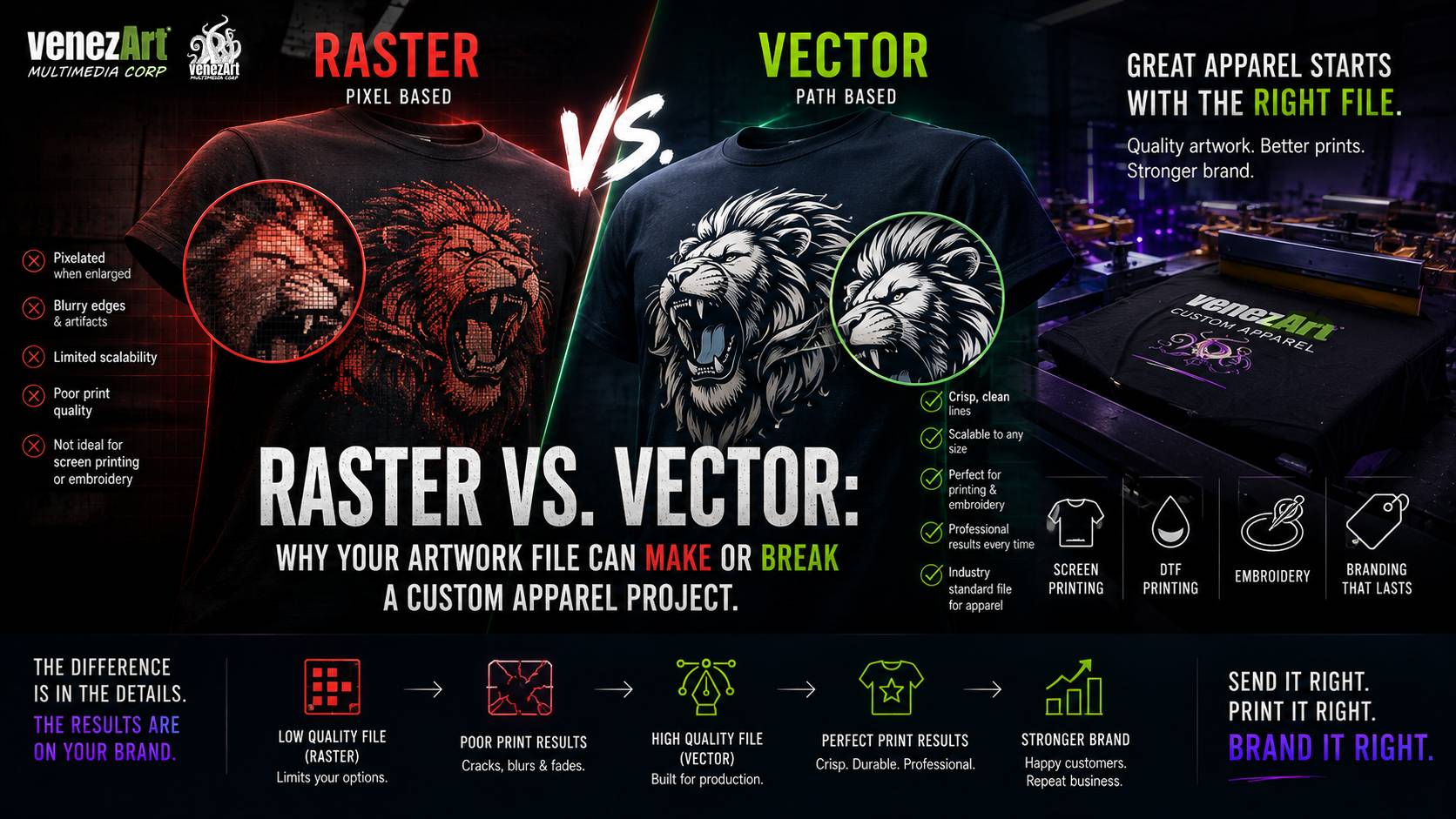
What Is a Raster File?
Raster artwork is made up of thousands or millions of tiny pixels.
Common raster file formats include:
• JPG / JPEG
• PNG
• PSD
• TIFF
Raster files work extremely well for:
📸 Photography
🎨 Digital paintings
🌈 Complex color gradients
🖼️ Highly detailed artwork
The challenge?
Raster images have a fixed resolution.
When you enlarge them too much, the pixels become visible. That can create blurry edges, jagged lines, and poor-quality details.
Think about zooming into a small photo until it starts looking like little squares.
That’s a raster image.
What Is a Vector File?
Vector artwork is created using mathematical paths, points, lines, and curves instead of pixels.
Common vector formats include:
• AI
• EPS
• SVG
• PDF (when properly created as vector artwork)
Because vector artwork uses mathematical paths, it can be scaled dramatically without losing quality.
A vector logo can be:
➡️ Printed on a business card
➡️ Enlarged for a storefront sign
➡️ Used on a small embroidered chest logo
➡️ Printed across the back of a T-shirt
…while remaining sharp and clean.
Raster vs. Vector: What’s the Difference?
RASTER = PIXELS
✔ Great for photographs
✔ Excellent for detailed artwork
✔ Works well at the correct resolution
❌ Can become blurry when enlarged
❌ Can create production challenges with low-quality artwork
VECTOR = PATHS
✔ Scales without losing quality
✔ Sharp, clean edges
✔ Easier to separate colors
✔ Better for logos and typography
✔ Ideal for many apparel decoration processes
👕 Why Vector Files Matter for Screen Printing
Screen printing is not simply about placing an image on a shirt.
Artwork often needs to be prepared for production through processes such as:
🎯 Color separation
🎯 Spot color preparation
🎯 Clean edges and shapes
🎯 Proper line thickness
🎯 Screen and film preparation
🎯 Artwork scaling and placement
A clean vector file gives the production team a much stronger starting point.
For example, imagine a company sends us a tiny JPG of their logo.
The logo may look fine on a website.
But when we need to print it larger on the back of a shirt, the artwork may become blurry or pixelated.
The logo might need to be:
• Recreated
• Vectorized
• Cleaned up
• Color corrected
• Separated for screen printing
Starting with professional vector artwork can reduce unnecessary production delays and help protect the quality of the brand.
⚠️ But Here’s an Important Detail…
Not every apparel design needs to be a vector file.
A full-color illustration, photograph, or highly detailed piece of artwork may be better as a high-resolution raster file.
The key is using the right file for the right production method.
A simple company logo?
👉 Vector is usually the best option.
A complex digital illustration?
👉 A properly prepared high-resolution raster file may be the better choice.
A screen-printed design with multiple spot colors?
👉 Vector artwork can make color separation and production much more efficient.
Your Artwork Is Part of the Production Process
Custom apparel isn’t just about choosing a shirt and pressing “print.”
The quality of your artwork affects:
✔ Print quality
✔ Color accuracy
✔ Production time
✔ Scalability
✔ Detail reproduction
✔ Consistency across products
✔ The final appearance of your brand
That is why professional artwork preparation matters.
At VenezArt, we don’t just look at whether artwork looks good on a computer screen.
We look at how it will perform in the real production process.
Because a great design should look just as good on a T-shirt, hoodie, uniform, promotional product, or wherever your brand goes next.
Have a logo or design but aren’t sure if your files are ready for printing?
Send VenezArt your artwork. We’ll help you understand what you have, what format you need, and what may need to be prepared before production.
Build Trust. Get Found. Generate Leads.
Schedule a quick consultation, and find out if your logo is ready for printing!


